Quick Answer
Fiberglass batts or blown-in fiberglass are cost-effective options for insulating suitable walls and attics, provided the material is installed to its specified depth without gaps or compression. Air-seal the assembly first, because fiberglass slows heat conduction but does not stop air leakage; use an appropriate vapor retarder where climate and assembly design require one.
Introduction
Fiberglass insulation is made from fine glass fibers that slow heat transfer. Batts fit open wall and ceiling cavities, while blown-in fiberglass can cover attic floors and fill hard-to-reach spaces. Both can be cost-effective, but the installed cost depends on the area, the amount of insulation needed, and the work required to fit it properly.
Air sealing matters just as much as coverage. Fiberglass does not stop air leaks, so gaps should be sealed before insulation goes in. In Jacksonville’s warm, humid climate, moisture control also deserves attention: wet insulation or poorly sealed spaces can undermine the work you paid for.

When evaluating fiberglass insulation, understanding how glass fibers manage heat flow across your thermal envelope helps determine the best fit for your project.
Understanding Fiberglass Insulation: Composition, R-Value, and Thermal Performance
Fiberglass has served as a primary thermal barrier in residential and commercial construction for over 80 years. It functions by trapping pockets of still air within an inorganic matrix of spun glass filaments, significantly reducing conductive and convective heat transfer through the building envelope. As detailed in Insulation Outlook Magazine’s overview of fibrous materials, these inorganic fibrous materials are engineered for stable thermal resistance across diverse structural applications.
Raw Materials and the Glass Wool Manufacturing Process
The production of fiberglass begins with raw silica sand, limestone, soda ash, and a substantial proportion of recycled glass cullet. These ingredients are melted in an industrial furnace at temperatures exceeding 2,500°F.

Once liquefied, the molten glass flows into high-speed rotary spinners perforated with thousands of micro-orifices. Centrifugal force extrudes the liquid glass into extremely fine, flexible fibers. A thermosetting resin binding agent is applied to hold the fibers together, after which the material is cured in a heated oven, cooled, and cut into dimensional batts or packaged as loose-fill material.
Thermal Conductivity, k-Value, and R-Value per Inch
The thermal performance of insulation is measured by thermal conductivity (k-value) and thermal resistance (R-value). Thermal conductivity measures the rate at which heat passes through a material; lower numbers indicate better insulating properties. Standard fiberglass exhibits an effective k-value of approximately 0.23 to 0.25 BTU-in/hr-ft²-°F at standard mean temperatures.
In terms of thermal resistance, standard fiberglass products deliver an R-value ranging from R-2.2 to R-2.7 per inch of thickness, with high-density batts reaching up to R-3.0 to R-3.8 per inch. Because fiberglass relies entirely on trapped, stationary air within its matrix, any density variations or external air currents passing through the material can create convective loops that diminish its real-world performance.
Major Types and Forms for Residential and Commercial Applications
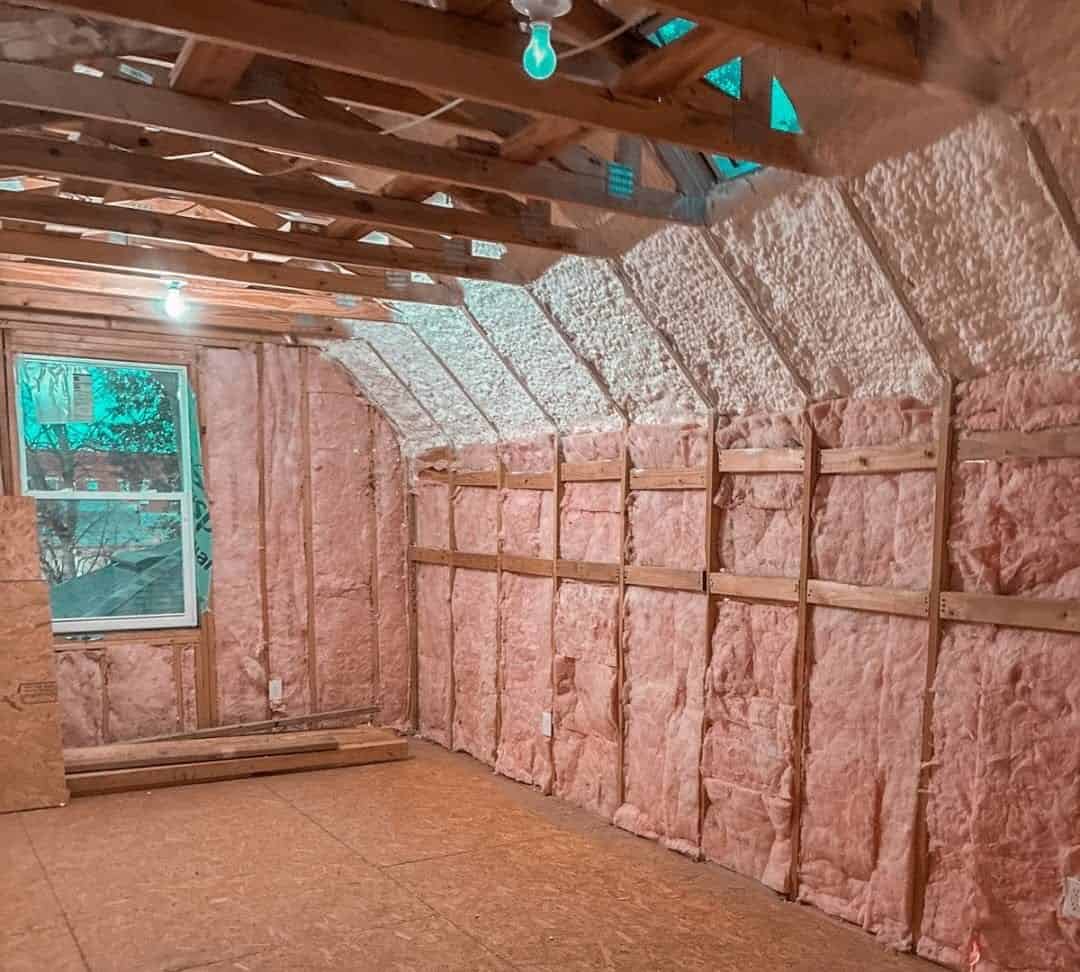
Fiberglass is manufactured in several distinct formats to accommodate different framing methods, access constraints, and building assemblies.
| Insulation Form | Typical R-Value per Inch | Primary Applications | Key Benefit |
|---|---|---|---|
| Pre-cut Batts | R-2.2 to R-3.8 | Open wall cavities, floor joists, standard framing | Easy friction-fit installation in standard stud bays |
| Continuous Rolls | R-2.2 to R-3.0 | Long uninterrupted framing cavities, attics | Fewer seams over long runs between joists |
| Blown-In (Loose-Fill) | R-2.2 to R-2.7 | Attic floors, irregularly spaced joists, retrofits | Seamless coverage over wiring and complex framing |
Traditional Batts and Rolls for Framing Cavities
Pre-cut batts and continuous rolls are engineered to fit standard 16-inch and 24-inch on-center framing bays. They are available either unfaced or faced with kraft paper, which acts as a vapor retarder to manage moisture migration.
Batts are widely selected for wall insulation during new construction or complete remodels where wall cavities are open and accessible. They are also frequently used for crawl space insulation beneath subflooring, provided they are supported properly to prevent sagging and moisture accumulation.
Blown-In Fiberglass Insulation for Attics and Enclosed Cavities
For horizontal assemblies and retrofits, blown-in fiberglass insulation provides continuous, uniform coverage across attic floors. Using a pneumatic blowing machine, loose glass fibers are distributed across the space, covering ceiling joists, bridging structural gaps, and filling voids around electrical junction boxes and wiring.
When upgrading attic insulation, blown-in material helps eliminate thermal bridging across joists without requiring custom cuts. Unlike older organic materials, loose-fill fiberglass maintains its loft over time when installed at the manufacturer’s specified density and kept dry.
Comparing Costs, Benefits, and Material Trade-offs

Selecting between insulation materials requires evaluating upfront costs, thermal needs, moisture resistance, and air sealing capabilities.
| Feature / Metric | Fiberglass Batts / Blown-In | Open-Cell Spray Foam | Closed-Cell Spray Foam |
|---|---|---|---|
| R-Value per Inch | R-2.2 to R-2.7 (Standard) | R-3.5 to R-3.8 | R-6.0 to R-6.8 |
| Inherent Air Barrier | No (Requires separate air sealing) | Yes (At nominal thicknesses) | Yes (Continuous impermeable barrier) |
| Moisture Absorption | Fibers hold water if exposed | Permeable to water vapor | Impermeable water barrier |
| Typical Role | Lower upfront cost thermal fill | Thermal and air barrier | Maximum R-value, structural rigidity |
Material Advantages and Cost Comparison
Fiberglass offers a budget-conscious option for insulating large surface areas. It is non-combustible, naturally resistant to rot when dry, and provides sound attenuation between interior rooms.
However, fiberglass does not stop airflow. For complex building envelopes, unvented rooflines, or tight crawl spaces, residential spray foam insulation can provide an integrated thermal and air barrier in one application. The ideal choice depends entirely on your specific framing, project goals, and moisture control requirements.
[Pro tip:] When installing fiberglass batts around electrical wiring or plumbing runs, always split the batt longitudinally along its thickness and sandwich the obstruction rather than crushing the whole batt behind or over the pipe.
Moisture Sensitivity, Air Movement, and Vapor Retarder Requirements
Because fiberglass is an open-fiber material, air can move through it if structural boundaries are not sealed. In hot, humid climates like Northeast Florida, outdoor moisture driven inward by solar heat can enter unsealed cavities. If humid air contacts cooler surfaces, condensation can form inside the assembly.
When fiberglass becomes damp from condensation or roof leaks, trapped water displaces air pockets, reducing thermal performance. In severe cases, prompt insulation repair or replacement is necessary to restore performance.
Installation Best Practices, Air Sealing, and Building Standards
A proper fiberglass installation requires careful attention to detail. Common installation errors that compromise performance include:
- Compression: Compressing a 6-inch batt into a 3.5-inch cavity reduces its trapped air volume and lowers its effective R-value.
- Voids and Gaps: Small gaps around framing members allow air bypass, degrading overall wall performance.
- Torn Vapor Facing: Unsealed tears in kraft paper facing allow vapor drive into the framing cavity.
When upgrading older or compromised assemblies, thorough insulation removal should be completed prior to installing fresh insulation, allowing full visual inspection and sealing of structural penetrations.
Health Safety, Exposure Limits, and Personal Protective Equipment
Working with fiberglass requires appropriate personal protective equipment (PPE). Direct contact with glass fibers can cause temporary mechanical irritation to the skin, eyes, and upper respiratory tract.
Installers should wear:
- A well-fitted particulate respirator (such as an N95 mask)
- Safety goggles with side shields
- Loose-fitting, long-sleeved clothing and work gloves
The Occupational Safety and Health Administration (OSHA) maintains a voluntary workplace exposure limit of 1 breathable glass fiber per cubic centimeter of air over an 8-hour workday. Extensive studies reviewed by the International Agency for Research on Cancer (IARC) determined that insulation glass wool is not classifiable as a human carcinogen, and the National Academy of Sciences concluded that glass fibers do not appear to increase the risk of respiratory cancer. Further health details can be found in the Synthetic Vitreous Fibers ToxFAQs from the ATSDR and the Washington State Department of Health fiberglass guidelines.
ASTM Standards, Fire Safety Ratings, and Air Sealing Synergy
Building materials must comply with specific manufacturing and fire safety benchmarks:
- ASTM C665: Standard specification for mineral-fiber blanket thermal insulation for light frame construction.
- ASTM C553: Governs mineral fiber blanket thermal insulation for commercial and industrial applications.
- Surface Burning Characteristics (ASTM E84): Most unfaced fiberglass products achieve a Flame Spread Index of 25 or less and a Smoke Developed Index of 50 or less (25/50 rating), permitting their use in return-air plenums and exposed framing.
For optimal energy efficiency, air sealing must be completed alongside fibrous insulation. Sealing top plates, wire penetrations, and duct chases prevents conditioned indoor air from escaping into unconditioned attic spaces.
Frequently Asked Questions
How does fiberglass compare to spray foam?
Fiberglass provides an R-value of roughly R-2.2 to R-2.7 per inch and serves as a cost-effective thermal barrier. It does not stop airflow on its own. Spray foam delivers higher R-value per inch (R-3.5 to R-6.8) and expands to fill irregular gaps, creating an integrated air barrier. The right choice depends on your structural design, space constraints, and budget.
Does fiberglass insulation cause cancer or long-term health risks?
No. In 2001, the International Agency for Research on Cancer (IARC) removed insulation glass wool from its list of possible carcinogens, classifying it as Group 3 (not classifiable as to its carcinogenicity to humans). While loose fibers can cause temporary skin, eye, and throat irritation, proper PPE prevents discomfort during installation.
Why is air sealing required before installing fiberglass?
Fiberglass slows conductive heat flow through glass filaments and trapped air pockets, but it is air-permeable. Without comprehensive air sealing, warm, humid air can pass through the insulation via gaps and cracks, reducing the system’s effective performance and increasing cooling loads on your HVAC system.
Conclusion
Optimizing your home’s insulation system with the right balance of air sealing and thermal insulation helps protect indoor comfort and manage cooling demands in hot, humid climates. Whether adding blown-in material to an existing attic or insulating new construction framing, professional installation ensures material is fitted to exact specifications without compression or thermal gaps.
To evaluate your home or commercial building and discuss your insulation options, call Clark Spray Foam at (904) 885-9983 or request a free quote.