Quick Answer
Attic spray foam can help reduce heat gain and air leakage when installed at the appropriate insulated boundary. Roof-deck insulation suits plans that bring attic ductwork inside that boundary, while attic-floor insulation keeps the attic vented. A professional inspection should guide the choice based on roof condition, existing insulation, and moisture control.
Is spray foam insulation right for your attic?
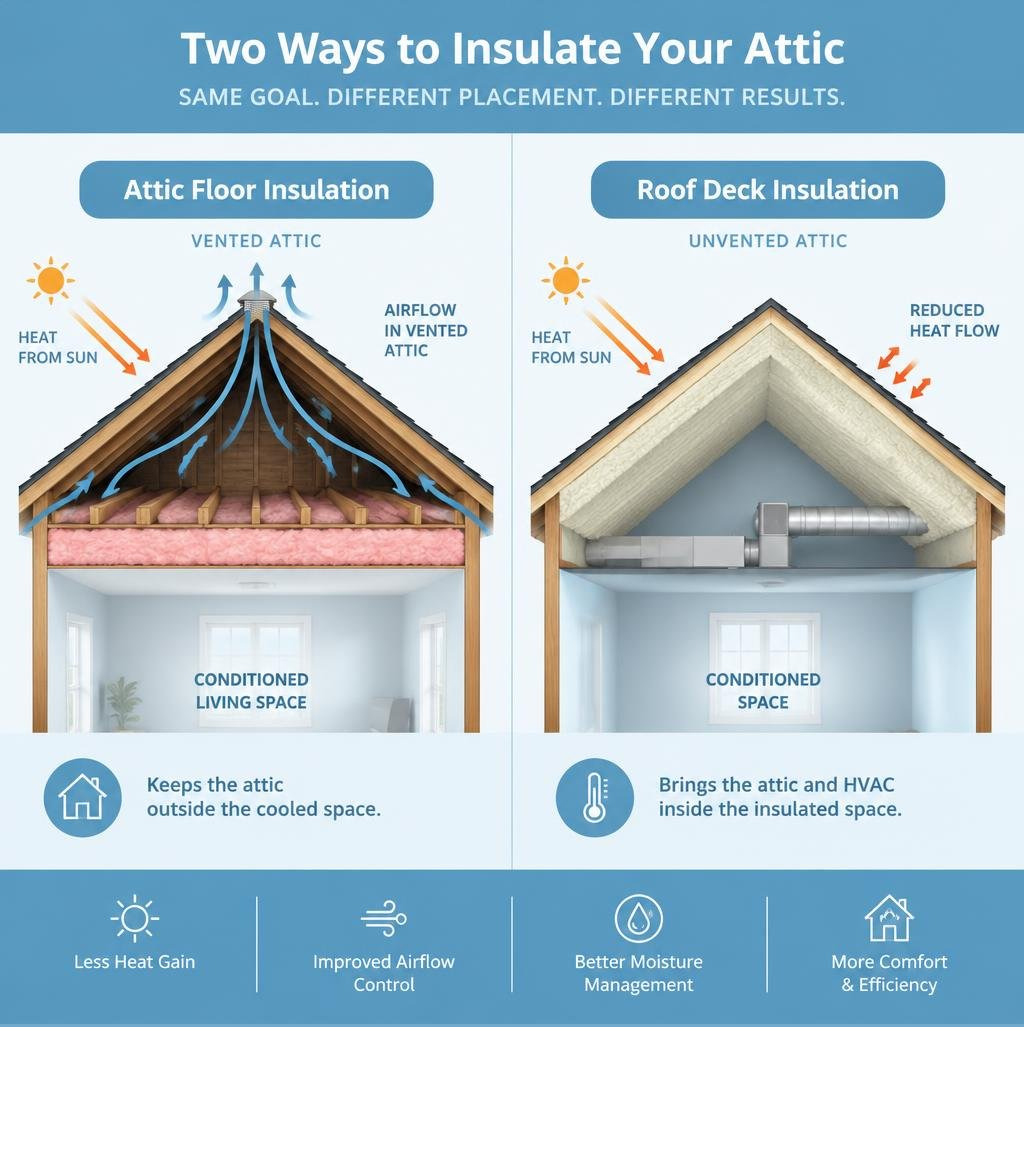
In the attic, spray foam insulation can help keep Jacksonville homes cooler by reducing heat flow and sealing gaps that let air move between the attic and living space. The first choice is where to put it: on the attic floor to keep a vented attic outside the cooled space, or along the roof deck to bring the attic and its HVAC equipment inside the insulated space. The better option depends on your ducts, existing insulation, roof condition, and moisture-control plan.
In Northeast Florida’s hot, humid climate, a cooler attic can ease the load on your AC and help with hot upstairs rooms. Project costs depend on foam type and preparation needs, and installation requires care. At Clark Spray Foam, we’re a family-owned Jacksonville contractor with over 15 years of experience; owner Michael Clark is on every job, and we don’t use subcontractors.
Understanding how insulation interacts with building science helps you choose between traditional methods and modern attic insulation strategies. For suitable buildings, spray foam can address air sealing, moisture-control needs, and hard-to-reach spaces, while fiberglass is a lower-cost option for adding or topping up insulation. The best choice depends on the building, so have the attic inspected before deciding.
Vented vs. unvented attics: How attic spray foam strategies work
The performance of an attic hinges on where you establish the building’s insulated and air-sealed boundary—the continuous boundary that separates indoor conditioned air from outdoor elements. In residential construction, two primary design strategies dictate how attics manage thermal performance, airflow, and moisture control.
A vented attic establishes the thermal boundary along the flat attic floor (the ceiling plane of the top floor). Outside air flows freely through soffit, gable, or ridge vents to provide attic ventilation. The attic itself remains unconditioned, matching closer to outdoor ambient temperatures.
An unvented attic assembly (often called an encapsulated or conditioned attic) moves that thermal boundary directly up to the sloped underside of the roof deck. Applying spray foam to the underside of the roof deck seals the attic and brings it inside your home’s conditioned space.
Traditional Attic Floor Air Sealing vs. Conditioned Roof Decks
Applying insulation to the attic floor versus the roof deck fundamentally changes how a house breathes and handles summer heat.
On a vented attic floor, the priority is eliminating air bypasses. Gaps around ceiling electrical boxes, plumbing chases, recessed lighting fixtures, and wall top plates allow cooled indoor air to escape into the attic. Applying a layer of spray foam over the attic floor can create a continuous air-control layer that helps reduce this unwanted air exchange. Guidance from the Building America Solution Center on spray foam applied to existing attic floors highlights that combining an air-impermeable seal on the ceiling deck with proper soffit-to-ridge ventilation baffles keeps the ventilation path clear while reducing convective energy loss.
[Pro tip:] Before insulating a vented attic floor, have the installer check that the eave baffles are in place and the soffit airflow paths are clear.

When encapsulating the roof deck, all exterior passive vents are sealed off. The spray foam is applied to the underside of the roof deck. This can help limit humid outdoor air leakage and slow heat flow into the attic.
The Building Science of Managing Ductwork Inside the Insulated Boundary
In many Northeast Florida homes, air handlers and flexible distribution ducts are located inside the attic. In a traditional vented attic, the attic can become very hot in summer.
Attic ductwork leaves the cooling system operating in a hot space. The Clark Spray Foam attic insulation guide explains why bringing that equipment inside the insulated boundary can help.
Moving the thermal boundary to the roof deck with spray foam brings the duct system and mechanical equipment inside the home’s insulated boundary. This can help lower attic temperatures during peak summer days, reduce heat exposure for attic equipment, and ease AC load.
Comparing Foam Types: Moisture Control and Thermal Boundaries
Selecting the right foam for an attic requires balancing thermal resistance, vapor permeance, and available installation space.
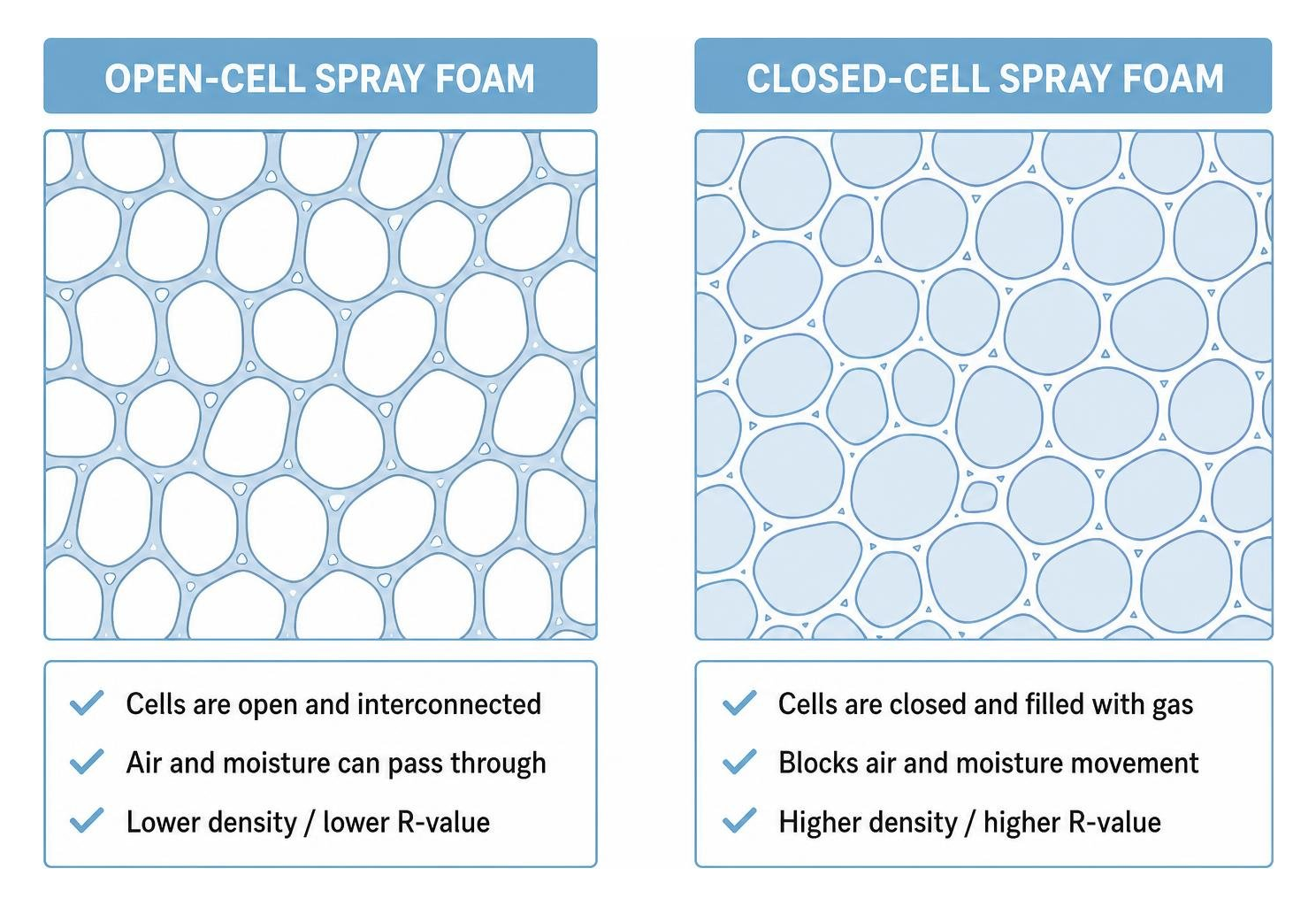
Comparing open-cell and closed-cell spray foam insulation in the attic
The two core spray foam categories are low-density open-cell and medium-density closed-cell. Our detailed overview of open-cell vs closed-cell spray foam explains how their physical properties suit different building assemblies and is the source for the typical values in the table below.
| Feature / Metric | open-cell spray foam (about 0.5 lb/cu ft) | closed-cell spray foam (about 2 lb/cu ft) |
|---|---|---|
| Typical R-value | About R-3.6 per inch | About R-6 per inch |
| Texture and rigidity | Soft and flexible | Rigid and dense |
| Air sealing | Insulates and air-seals | Insulates and air-seals |
| Vapor control | Not a vapor retarder | Acts as a vapor retarder at about 2 inches |
| Moisture Absorption | Can absorb water if exposed to liquid | Hydrophobic; rejects bulk water absorption |
| Primary Attic Role | Deep rafter roof decks, sound dampening | Shallow rafters, roof decks needing vapor control |
Moisture exposure and foam selection
In Northeast Florida, moisture exposure is an important factor when selecting insulation. The Clark Spray Foam comparison guide explains how the two foam types handle moisture differently.
The open-cell type can absorb water, while closed-cell foam does not absorb water and can act as a vapor retarder—a material that limits water-vapor movement. Those differences should inform the attic’s moisture-control plan.
Closed-cell foam can support vapor control when it is used at an appropriate thickness. Have the attic inspected to determine the right foam and moisture-control approach for the assembly.
Planning the attic insulation boundary
The insulation location should be selected after inspecting the roof, attic, and existing materials.
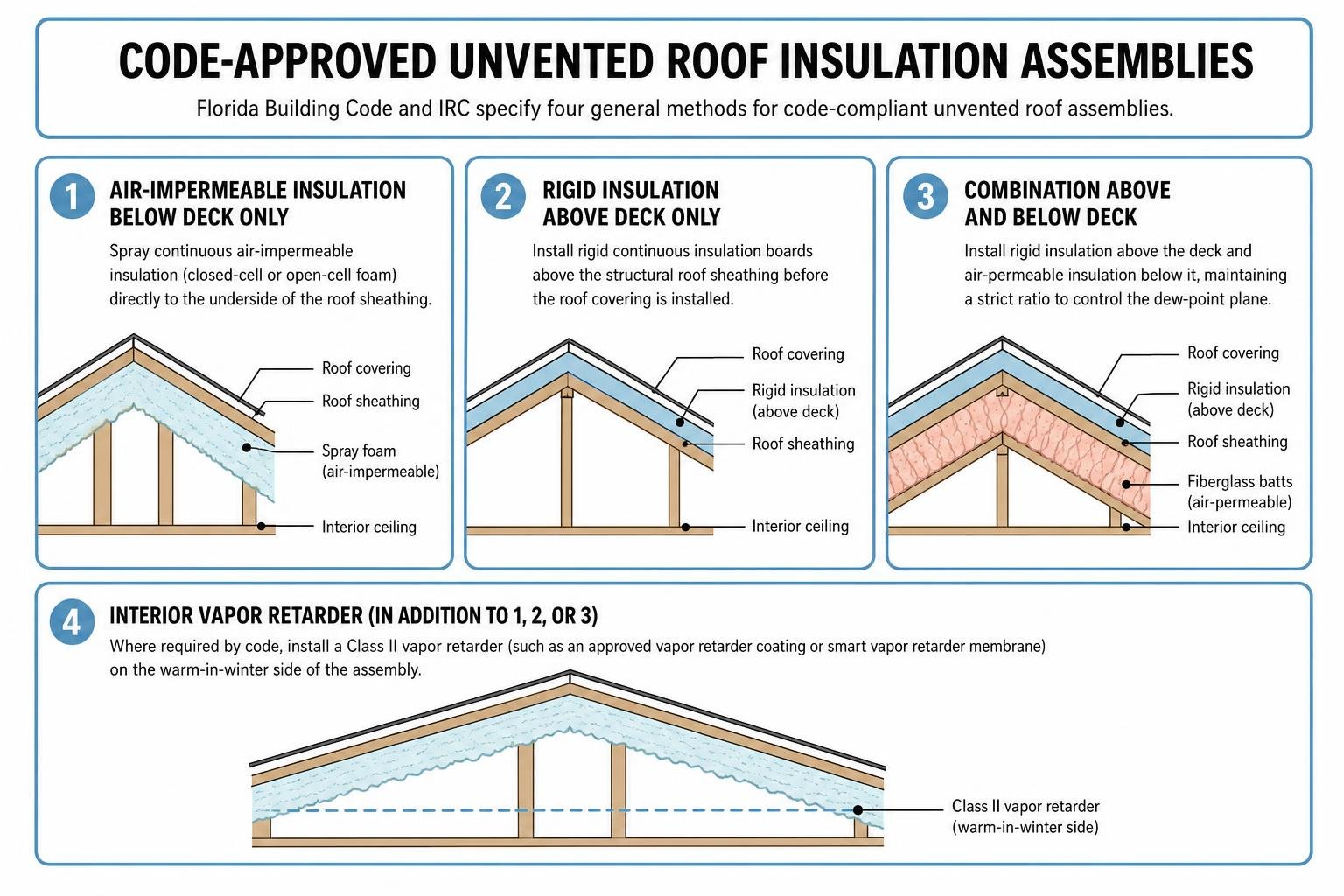
Consult the Florida Building Code when planning the project. For a vented attic-floor approach, the Building America Solution Center describes the following preparation steps:
- Inspect the roof and attic, and repair existing leaks.
- Remove existing insulation and debris.
- Assess ceiling penetrations for air sealing.
- Verify ventilation paths and soffit baffles.
Keep vented-attic airflow paths clear
For a vented attic-floor installation, the Building America Solution Center calls for proper attic ventilation and a baffle at each soffit vent to keep the ventilation path clear.
Combining spray foam with fibrous insulation
The Building America Solution Center describes applying closed-cell spray foam along a vented attic floor to form an air-control layer, then adding fibrous insulation to reach the required R-value.
The remaining target R-value is then completed using fiberglass insulation batts or blown-in fiberglass insulation. The appropriate combination depends on the attic and should be assessed during an inspection.
Real-World Performance: Benefits, Trade-Offs, and Attic Floor Insulation
Upgrading an attic involves assessing the existing materials, potential trade-offs, and long-term building durability.

Should You Remove Existing Attic Floor Insulation Before Spraying?
When converting a vented attic to an unvented conditioned space by spraying the roof deck, what happens to old insulation on the floor?
Leaving existing fiberglass or cellulose on the attic floor might seem like a way to keep “extra” insulation, but removal may make sense when switching insulation approaches. Consider these factors:
- Changing the insulation boundary: Have the existing floor insulation assessed when moving insulation to the roof deck.
- Existing damage: Check whether insulation is wet, matted, or stained before deciding what to retain.
When existing insulation needs to come out, professional attic insulation removal can clear the attic for assessment and replacement insulation. Furthermore, if previous roof leaks have compromised materials, address the leak and replace water-damaged insulation.
Checking for Moisture and Roof Leaks
Homeowners occasionally worry about potential risks associated with roof deck spray foam, particularly regarding roof leak detection.
Before insulating, have the roof and attic inspected and repair existing leaks. The Building America Solution Center includes these checks in its attic-retrofit guidance.
Clark Spray Foam uses its own crew, with owner Michael Clark on every job.
How Attic Insulation Can Help Manage Summer Heat
In Jacksonville summers, the sun heats the roof. Insulation can help slow heat moving from the attic into the living space below.
The Clark Spray Foam attic insulation guide explains that roof-deck insulation can bring attic equipment into a cooler space. A cooler attic can help reduce AC load and improve comfort in hot upstairs rooms.
Preparation and professional installation
Attic preparation should be part of the installation plan, not an afterthought.
Prepare the attic before insulation
For an existing attic-floor retrofit, the Building America Solution Center calls for removing old insulation, debris, and dust before applying spray foam.
The same BASC guide calls for checking that bath fans discharge outdoors and that attic-floor penetrations can be adequately sealed.
Inspection and crew oversight
An inspection should account for the roof condition, existing insulation, attic ventilation, and the location of AC equipment.
- Air sealing: Check whether attic-floor penetrations need additional sealant or rigid blocking, as described in the BASC guide.
- Surface preparation: Remove dust and debris before an attic-floor spray foam installation, following the BASC preparation guidance.
- Owner-on-site oversight: Clark Spray Foam uses its own crew, and owner Michael Clark is on every job.
Frequently asked questions about attic spray foam
Can you spray foam an attic floor without sealing the roof deck?
Yes. Spraying a vented attic floor can help create a continuous air-control layer along the ceiling. When taking this approach, the roof remains traditionally vented with open soffit and ridge vents, and ventilation baffles are installed at the eaves to keep airflow pathways clear from the foam.
What affects the cost to install spray foam insulation in an attic?
Attic insulation project costs vary based on several site-specific factors:
- Foam selection and insulation level: The Clark Spray Foam comparison guide explains that open-cell and closed-cell foam differ in cost per R-value—the measure of resistance to heat flow.
- Preparation needs: The Building America Solution Center describes removing existing insulation, debris, and dust and adding air sealing where needed before an attic-floor installation.
Request an on-site inspection and a free quote to compare the appropriate options and pricing for your home.
Conclusion
Upgrading your home with spray foam insulation in the attic can help manage heat gain, moisture movement, and air leakage. Whether encapsulating the roof deck to bring your HVAC system inside a conditioned space or air-sealing the attic floor, appropriate design and installation can support lasting comfort across Northeast Florida’s demanding summer seasons.
For expert guidance and a personalized assessment of your attic, contact Clark Spray Foam at (904) 885-9983 or request your free quote at https://clarksprayfoam.com/contact-us/.